


The Four Kingdoms of Nature A Spagyric Journey Through Alchemy

Nature does not appear all at once. It rises in orders of complexity, from stone to root, from instinct to self-awareness. For the alchemist, these orders were not separate worlds, but living chapters in one great book.
The ancient understanding of the four kingdoms of Nature names these chapters as Mineral, Plant, Animal, and Human. Each kingdom reveals a different way that life organizes itself. Each shows a different relationship between matter, movement, perception, and consciousness.
In Alchemy, this way of seeing is not abstract philosophy alone. It is a practice of attention. The alchemist studies the mineral body of the Earth, the intelligence of plants, the feeling life of animals, and the reflective awareness of the human being. Together, they form a map of transformation.
For Synergy Alchemy, this map is especially meaningful in the Spagyric tradition. To work with plants is not simply to extract compounds from herbs. It is to observe, separate, purify, transform, and reunify the different aspects of Nature, while remembering that the same patterns found in the leaf, root, and flower also live within us.

The four kingdoms reveal Nature as an ordered living whole
The four kingdoms are often described in a rising order of organization:
Mineral
Plant
Animal
Human
This order does not mean that one kingdom is “better” than another. It means each one expresses Nature through a different level of structure and activity.
The Mineral Kingdom offers stability and foundation. The Plant Kingdom introduces growth, rhythm, and transformation. The Animal Kingdom brings movement, instinct, and sensation. The Human Kingdom adds self-awareness, symbolic thought, and the capacity to participate consciously in transformation.
This view appears throughout Hermetic philosophy, where the visible world is treated as a mirror of hidden principles. The familiar Hermetic phrase “as above, so below” points toward the relationship between the microcosm and macrocosm. The small reflects the large. The human body reflects the Earth. The form of a plant reflects the larger rhythms of sun, moon, season, soil, and sky.
Alchemy studies these reflections through matter. It asks a simple but profound question: what is Nature doing, and how can we learn to work with it respectfully?
In this sense, the four kingdoms are not only categories. They are teachers.
The Mineral Kingdom gives Nature structure and foundation
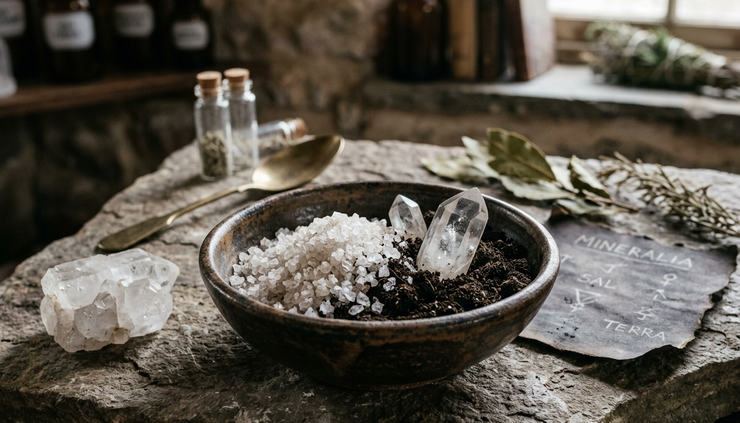
The Mineral Kingdom is the body of the Earth in its most enduring form. It includes stones, salts, metals, crystals, clays, and the mineral matrix that supports life.
In alchemical thought, minerals represent structure, density, memory, and foundation. They form the bones of the planet. They shape mountains, riverbeds, caves, and soils. They also provide the elemental substances that plants draw upward and transform into living tissue.
Salt is especially important in the alchemical imagination. Common salt preserves, crystallizes, and gives form. In Spagyrics, Salt is also one of the three philosophical principles, along with Sulfur and Mercury. It represents the fixed body, the stable vessel, the mineral residue, and the principle of embodiment.
The alchemist did not view mineral matter as “dead” in the modern casual sense. Instead, minerals were understood as the most fixed expression of Nature. They change slowly, through pressure, heat, dissolution, crystallization, and time. Their transformation happens at a pace far beyond ordinary human attention.
A piece of quartz, a vein of copper, or a pinch of sea salt may seem still. Yet each one carries the story of Earth processes. Heat, water, gravity, and chemistry have all shaped it.
The Mineral Kingdom reminds us that transformation requires a vessel. Without structure, nothing can take form. Without the mineral body of the Earth, no root can anchor, no seed can sprout, and no animal body can be built.
For the Spagyric practitioner, this lesson matters. The mineral level of a plant preparation is not an afterthought. The salts left after calcination, purification, and recombination represent the fixed body of the plant. They carry the principle of form back into the final preparation.
The Plant Kingdom transforms mineral matter into living form
Plants stand between Earth and sky. They root in mineral soil, drink water, open to sunlight, and build living form from what appears simple and raw.
This is one reason the Plant Kingdom holds such a central place in botanical traditions and Spagyrics. Plants perform a visible alchemy every day. They take mineral matter, water, air, and light, then organize them into root, stem, leaf, flower, fruit, seed, fragrance, color, and taste.
The plant does not move through the world like an animal, yet it is not passive. It responds. It grows toward light. It follows seasonal rhythms. It opens and closes. It produces aromatic resins, bitter compounds, sweet nectars, pigments, and volatile oils. It senses its environment in ways that are different from animal sensation, but deeply intelligent in their own form.
This is botanical intelligence. Not human thought, not animal instinct, but a plant way of being.
Plants as mediators between Earth and cosmos
Traditional alchemy often viewed plants through planetary relationships. Certain herbs were associated with the Sun, Moon, Venus, Mars, Jupiter, Mercury, or Saturn based on qualities such as color, form, scent, taste, growth pattern, and traditional use.
For example, solar plants were often linked with warmth, radiance, and golden flowers. Lunar plants were associated with moisture, softness, nighttime rhythms, or pale blossoms. These associations were part of a symbolic language, not a modern scientific classification.
This language helped practitioners observe more closely. It invited them to ask:
What does this plant express?
Where does it grow?
What season calls it forth?
What scent, taste, color, or gesture does it carry?
How does it shift from seed to flower to decay?
Aromatic plants are especially valued in this tradition because fragrance is linked with volatility and subtle movement. The rising scent of rosemary, lavender, sage, rose, or frankincense shows how a plant can release something that travels beyond its physical form.
Sulfur, Mercury, and Salt in the plant
In Spagyric philosophy, every natural thing contains three philosophical principles:
Sulfur
The principle of soul, essence, warmth, color, and individuality. In a plant, Sulfur is often associated with its essential oils, aromatic nature, and unique character.
Mercury
The principle of spirit, fluidity, movement, and transformation. In plant work, Mercury is linked with the volatile and circulating aspects, traditionally represented by the purified spirit or menstruum that carries and transforms.
Salt
The principle of body, form, structure, and mineral fixity. In Spagyrics, Salt is represented by the purified mineral body of the plant, often recovered through careful calcination and purification.
These are not the same as the chemical elements sulfur and mercury in the modern laboratory sense. They are philosophical principles, part of an older symbolic language used to describe how Nature organizes itself.
Spagyric work honors all three. A plant preparation is not only about pulling out desirable substances. It is a process of listening to the plant’s whole being through separation, purification, transformation, and reunion.
The plant is taken apart so it can be understood. It is purified so its principles can be clarified. It is reunited so a more integrated expression may emerge.

The Animal Kingdom brings movement, instinct, and feeling
The Animal Kingdom introduces a more mobile and sensory expression of life. Animals move through the world with appetite, instinct, perception, emotion, and response.
Where plants grow in place, animals seek, flee, nest, migrate, hunt, protect, bond, play, and communicate. They meet the world through senses that are often sharper than our own. A hawk sees with extraordinary precision. A deer reads subtle changes in sound and scent. A bee navigates through light, pattern, and relationship to the hive.
In alchemical terms, the Animal Kingdom makes the life force more animated and responsive. Desire becomes more visible. Emotion becomes more complex. The body becomes an instrument of movement.
This kingdom teaches the intelligence of sensation. It reminds us that life is not only structure and growth. It is also contact, response, and feeling.
The animal body is a bridge between the plant world and human self-awareness. Like plants, animals depend on mineral foundations and living nourishment. Like human beings, they experience the world through nervous systems, moods, bonds, and memory.
The alchemist observing animals would see Nature becoming more interior. Experience gathers inside the creature. The outer world leaves impressions. The animal responds from within.
This does not require romantic language. Anyone who has watched a bird build a nest, a horse sense tension, or a dog track a scent can see that animal life carries a rich field of awareness. It may not be reflective consciousness in the human sense, but it is far from mechanical.
The Animal Kingdom asks us to respect embodied knowing. The body feels before the mind explains.
The Human Kingdom participates consciously in transformation
The Human Kingdom introduces a distinct capacity: self-awareness. Human beings can observe Nature and also observe themselves observing. We can ask what a thing means. We can choose, refine, imagine, create, and take responsibility for our participation in the living world.
This is why Alchemy places the human being in a special position, not above Nature, but within it as a conscious participant.
The alchemist works with matter while being changed by the work. Fire, vessel, herb, mineral, time, patience, failure, and repetition all become teachers. The outer operation mirrors an inner process.
To separate a plant into Sulfur, Mercury, and Salt is also to contemplate the parts of one’s own life:
What is essential and individual?
What is fluid, changeable, and in motion?
What is fixed, embodied, and ready to be purified?
What needs to be reunited with greater clarity?
This is the heart of Spagyric practice. The word is often explained through the Greek roots associated with separating and recombining. The process reflects a larger principle: transformation requires both distinction and reunion.
If we never separate, we cannot understand the parts. If we never reunite, we remain fragmented.
Human creativity follows the same pattern. A musician separates tone, rhythm, silence, and gesture, then reunites them as song. A gardener separates seed, soil, water, compost, and season, then brings them into relationship. A maker of Spagyric preparations separates plant principles, purifies them, and reunites them with care.
The Human Kingdom carries the responsibility of conscious attention. We can reduce Nature to a resource, or we can meet it as relationship. The alchemical path asks for the second way.

Spagyric practice remembers the wholeness of Nature
Spagyrics belongs to an old stream of alchemical plant work. It draws from Hermetic philosophy, traditional botanical knowledge, and the disciplined observation of natural processes.
At its best, it asks the practitioner to slow down. Before any technique, there is relationship.
A plant is not only material. It is also season, place, scent, form, timing, planetary symbolism, mineral uptake, water movement, and human attention. It belongs to the soil that held it, the weather that shaped it, and the hands that gathered it.
The Spagyric method reflects this wider view through stages:
Observation
The practitioner studies the plant’s form, habitat, aroma, texture, taste, and rhythm.
Separation
The plant is divided into philosophical principles so each aspect can be worked with more clearly.
Purification
Each part is refined according to its nature. The fixed is treated differently from the volatile.
Transformation
Fire, time, circulation, and digestion help alter the material and reveal new qualities.
Reunion
The purified aspects are brought back together, expressing a renewed wholeness.
This approach does not need exaggerated claims. Its value lies in the depth of attention it cultivates. It teaches patience, precision, reverence, and a direct relationship with the plant world.
For Synergy Alchemy, the four kingdoms provide a living framework for this practice. Mineral gives body. Plant gives growth and transformation. Animal gives sensation and movement. Human gives reflective awareness and responsibility.
Together, they show that alchemy is not only concerned with rare substances or hidden formulas. It is concerned with how Nature becomes more conscious of itself through form, life, feeling, and reflection.
The study of the kingdoms brings us back to a simple truth: the human being is not separate from Nature. We are mineral in our bones, plant-like in our rhythms of growth and renewal, animal in our senses and emotions, and human in our capacity to witness and choose.
To study the kingdoms is to study ourselves without leaving the world behind. It deepens our relationship with plants because it shows us that every leaf is part of a larger order. It deepens our understanding of transformation because it reveals change as a pattern woven through all forms of life.
The alchemical journey through Nature begins with attention. A stone, a sprig of rosemary, the movement of an animal, and the quiet act of human reflection all belong to the same living mystery. When we learn to see them together, the world becomes less divided, and our place within it becomes more intimate, responsible, and alive.

Comments