


ORA ET LABORA Alchemical Plate Prayer, Work, and Hermetic Symbolism


A true alchemical image does not merely decorate an idea. It teaches through arrangement, contrast, and symbol. The imagined educational plate titled “ORA ET LABORA, Oración y Trabajo” belongs to that tradition. It presents transformation as a double path: inward attention and outward labor, prayer and experiment, silence and heat.
The phrase ora et labora is often associated with monastic discipline. In an alchemical setting, it gains a wider meaning. Prayer is not reduced to religious recitation, and work is not reduced to manual effort. Together, they describe a way of knowing. The alchemist contemplates the order of creation, then tests that order through matter. The plate becomes a map of this relationship.
Inspired by hermetic engravings of the 17th century, the composition would likely feel dense but ordered. Every object would carry meaning. Every gesture, vessel, star, and architectural detail would speak to the union of spirit and nature.

The plate follows the language of 17th-century hermetic engraving
Hermetic engravings from the 1600s often used visual compression. A single image could hold an entire teaching. Architecture, natural forces, sacred geometry, mythic figures, and laboratory tools appeared together, not as random decoration, but as a symbolic system.
The imagined ORA ET LABORA plate would follow this method. It would not separate the sacred from the practical. Instead, it would show them as two rooms in one house.
On one side stands the oratorium, a quiet chamber of devotion. On the other side stands the laboratorium, a place of fire, glass, metals, herbs, minerals, and careful observation. Between them there may be an arch, a shared wall, or a narrow doorway. This architectural connection matters. It tells the viewer that the two spaces are distinct, yet dependent on one another.
A visual reading might notice these elements:
A central doorway showing passage between contemplation and action
A vaulted ceiling over the oratory, suggesting sacred elevation
A furnace or athanor in the laboratory, suggesting sustained heat
Open books and instruments, showing study and measurement
Solar and lunar emblems above the scene, showing polarity and balance
Musical symbols or instruments, showing harmony among parts
The style would be restrained, not theatrical. Thin engraved lines would create depth. Dense cross-hatching would shape shadows. Latin labels would identify concepts rather than narrate a story. The whole design would feel like a diagram for meditation.
This is one reason Alchemy remains visually powerful. Its images rarely explain only one thing. They ask the viewer to read matter, spirit, time, and consciousness together.
The oratorium is the chamber of prayer and inner alignment
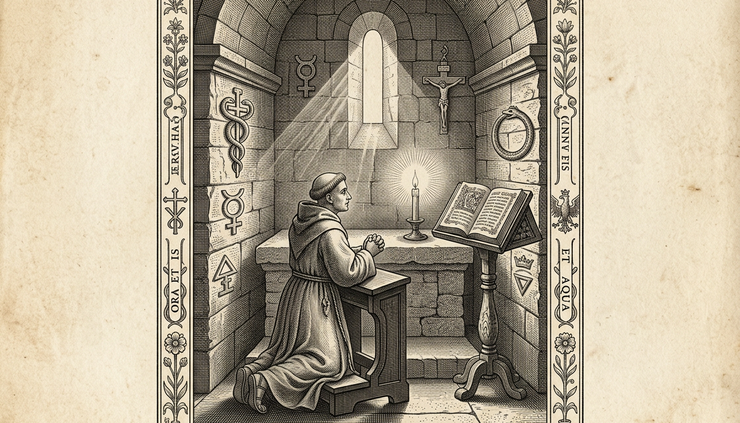
The left side, or upper side depending on the plate’s layout, would be labeled ORATORIUM, LA ORACIÓN. This is the sacred room of stillness. It represents the condition of the inner life before any meaningful transformation can begin.
The oratory might contain a kneeling figure, a small altar, a candle, a cruciform window, or an open book of prayers. These objects do not merely signal religion. They form a visual grammar of receptivity.
The candle suggests an interior flame. The open book suggests revealed wisdom and disciplined study. The window suggests the descent of light from beyond the individual self. The kneeling posture suggests humility, not weakness. In hermetic thought, humility is a method of perception. A mind filled with pride cannot see the subtle order of nature.
The sacred space also establishes the ethical tone of the plate. The alchemist is not shown as a reckless manipulator of substances. The work begins in reverence. The practitioner asks to be aligned with a greater order before touching the tools of transformation.
This gives the oratorium three functions.
It prepares attention.
Prayer gathers the scattered mind. It makes observation possible.
It purifies intention.
The plate suggests that power over matter must be guided by conscience.
It connects the visible and invisible.
The oratory reminds the viewer that material forms may reveal spiritual principles.
In this sense, prayer is not an escape from the world. It is a way of entering the world more carefully. The alchemist who prays is not refusing nature. They are learning how to meet it without violence, greed, or blindness.
The laboratorium is the workshop of nature’s transformation
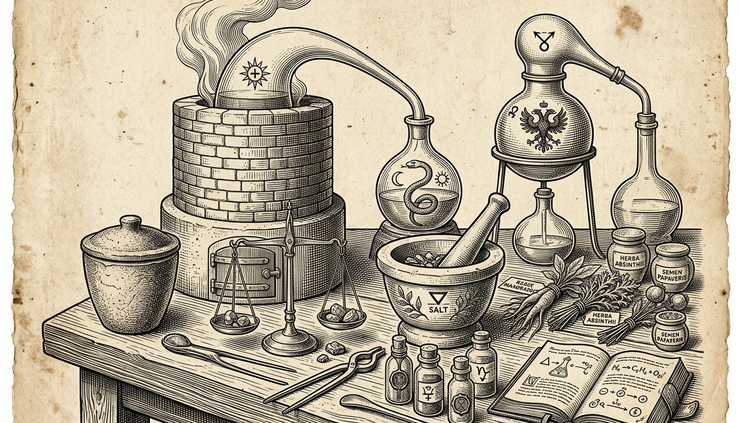
The other side of the plate would be labeled LABORATORIUM, EL TRABAJO. Here, the mood changes. The silence of the oratory gives way to vessels, heat, distillation, grinding, measuring, and watching.
A 17th-century-inspired laboratory would include an athanor furnace, retorts, alembics, crucibles, flasks, bellows, tongs, scales, and mortars. It might also include plants, salts, stones, and metals arranged on shelves. If the plate includes Herbal Botanical imagery, the plants would not appear as decoration alone. Leaves, roots, flowers, and seeds would show that nature’s forms contain hidden processes.
The laboratory teaches through contact with the real. The alchemist must observe color, vapor, residue, coagulation, dissolution, and timing. The work is patient. Fire must be controlled. Vessels must be sealed or opened at the proper moment. Materials resist fantasy. They answer only to process.
This gives the laboratorium its own spiritual dignity. It is not lower than prayer. It is prayer made practical through attention to matter.
Where the oratorium asks for contemplation, the laboratorium asks for discipline. It demands repeated work, accurate memory, and respect for consequence. A poorly tended flame ruins the operation. A careless mixture leads to failure. A rushed process destroys what could have matured.
The plate’s educational value lies in this balance. It warns against two errors.
One error is pure speculation without practice. The mind builds symbols but never tests them.
The other error is technical work without inner clarity. The hands produce effects, but the soul remains unchanged.
The central teaching is that transformation needs both. The laboratory without the oratory can become ambition. The oratory without the laboratory can become abstraction.
The joined architecture teaches that spirit and matter are not separate
The most important design choice is the union of the laboratory and the oratory. The two spaces may be placed side by side like wings of a single building. They may also share a central column, with prayer rising above and work unfolding below. In either arrangement, the plate rejects a simple split between sacred and material life.
The shared architecture may include a central axis. At the bottom, the earth holds minerals, roots, and water. In the middle, the human figure moves between prayer and work. At the top, celestial bodies shine over the entire scene. This vertical order suggests that transformation passes through levels:
Matter receives form.
The body performs action.
The mind observes pattern.
The spirit seeks illumination.
A doorway between the rooms might carry an inscription such as conjunctio, meaning union. This would point to a classic hermetic theme: the joining of opposites. Day and night, above and below, male and female, active and receptive, fixed and volatile. The plate does not erase these pairs. It brings them into relation.
The alchemist stands as the mediator. This figure does not dominate the scene. In many hermetic images, the practitioner appears small compared with cosmic forces. That size teaches proportion. The human being participates in transformation but does not own it.
A basin or fountain at the center could reinforce the lesson. Water receives light from both sides. From the oratory comes the light of prayer. From the laboratory comes the glow of the furnace. The basin gathers both. It becomes the image of consciousness itself, reflective, receptive, and ready for change.
The Sun, the Moon, and Music create a symbolic grammar
The requested symbols of the Sun, Moon, and Music give the plate a deeper structure. They are not side ornaments. They explain how the two chambers relate.
The Sun usually suggests clarity, gold, spirit, active force, and visible illumination. In the plate, it may appear above the laboratory or at the upper right, sending rays toward the furnace. This does not mean the Sun belongs only to work. It means that work requires light, heat, and direction.
The Moon suggests reflection, silver, receptivity, moisture, imagination, and rhythm. It may appear above the oratory or opposite the Sun. Its light is borrowed, softened, and inward. The Moon teaches that not all illumination burns. Some illumination reflects.
Together, the Sun and Moon form a pair. Their balance protects the plate from one-sided reading. Too much Sun becomes harsh force. Too much Moon becomes passivity. The alchemical path needs active fire and receptive stillness.
Music adds another layer. A lute, monochord, small organ, or notated staff might sit near the center of the image. In hermetic symbolism, music often represents proportion. It makes invisible order audible. A string vibrates according to number and tension. A chord forms harmony through difference.
Placed between the oratorium and laboratorium, Music becomes the sign of right relation. Prayer tunes the soul. Work tunes matter. The whole plate becomes an instrument, and the disciplined practitioner learns to hear when the parts are in accord.
This symbolic triad can be read simply:
Sun
Moon
Music
Active light, fire, clarity, conscious direction
Reflective light, receptivity, rhythm, inner perception
Harmony, proportion, timing, the union of differentiated parts
That final symbol, Music, is especially important for an educational plate. It reminds the viewer that transformation is not only about force. It is also about measure. The right note must sound at the right time. The right heat must meet the right vessel. The right intention must meet the right action.

The plate works as an educational tool for inner and material practice
As a teaching image, ORA ET LABORA would invite slow reading. It would not reveal all its meaning at once. A viewer might begin with the obvious division of prayer and work, then notice that the division is incomplete. The rooms are linked. The lights cross. Symbols repeat on both sides.
That structure makes the plate useful in several ways.
It can teach the history of hermetic visual language. The viewer learns how early modern images arranged spiritual and natural philosophy in the same frame.
It can also teach symbolic literacy. A furnace is not only a furnace. A candle is not only a candle. Each object has a practical role and a contemplative meaning.
Most of all, the plate teaches integration. The transformation of substances becomes a mirror for the transformation of the observer. The alchemist watches matter change through fire, solution, separation, and recombination. At the same time, the alchemist undergoes a parallel discipline: attention sharpens, intention purifies, patience grows, and perception deepens.
The plate’s power comes from refusing haste. Its engraved world asks for the opposite of quick consumption. It asks the viewer to pause, compare, and return. In that act of return, the image begins to do its work.
The oratorium says: become still enough to receive meaning.
The laboratorium says: become disciplined enough to give meaning form.
Together, they create a complete path. Prayer without work remains untested. Work without prayer risks losing its center. When joined, they show transformation as a movement from consciousness into matter, and from matter back into consciousness.
“La transformación comienza en la conciencia y se manifiesta a través del trabajo con la materia.”

Comments